"On the Morning of Christ's Nativity" by John Milton Read about this performance
Stanza
Text
Rehearsal Figure
Page
Comments
Introduction
If you click a rehearsal figure in the stanzas below:
a) the score will be positioned to the correct figure for display and playback
b) you must then scroll up manually to display the score page and player controls
c) you can then press the Play icon to restart playback from your chosen figure
I
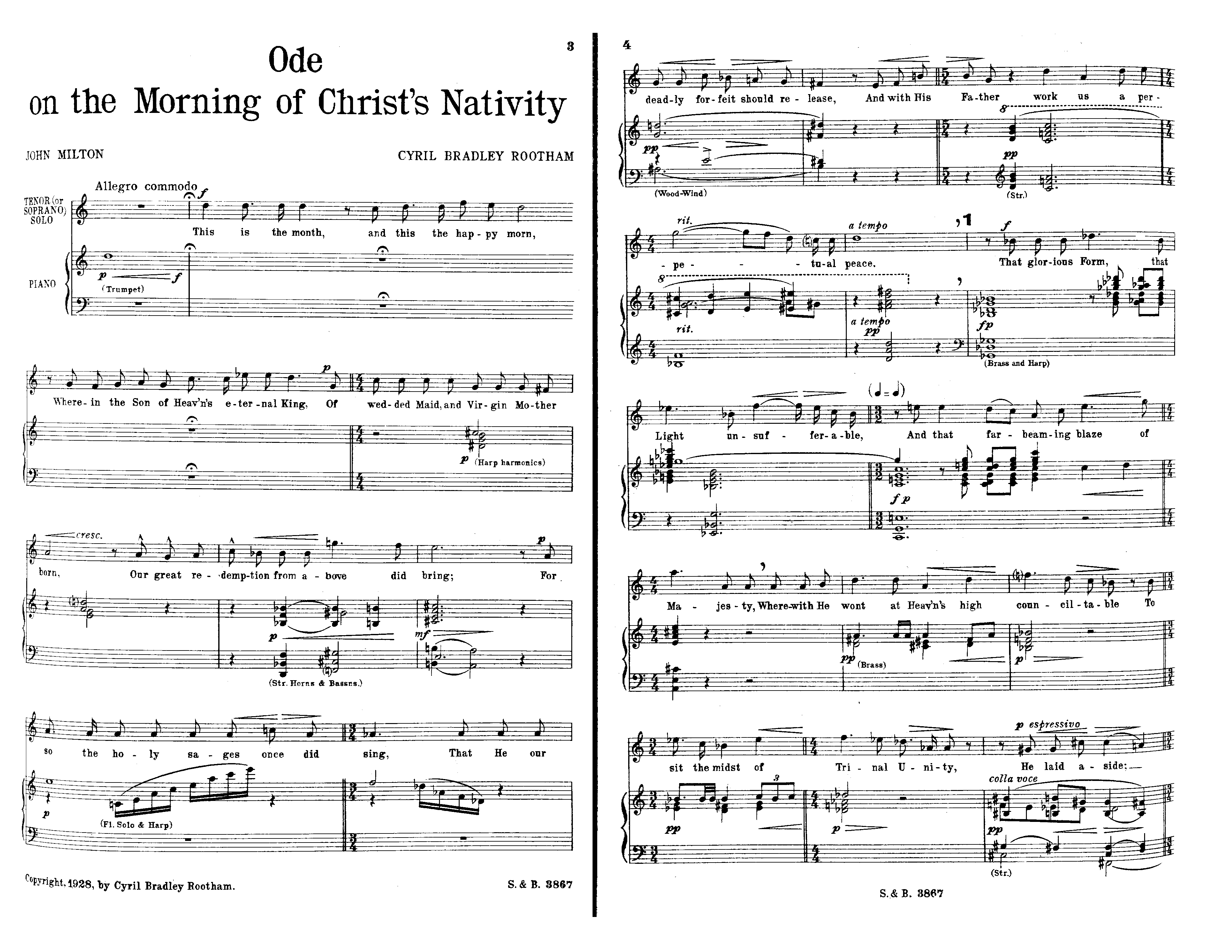
This is the Month, and this the happy morn
Wherein the Son of Heav'ns eternal King,
Of wedded Maid, and Virgin Mother born,
Our great redemption from above did bring;
For so the holy sages once did sing,
That he our deadly forfeit should release,
And with his Father work us a perpetual peace.
3
4
Tenor solo
II
That glorious Form, that Light unsufferable,
And that far-beaming blaze of Majesty,
Wherwith he wont at Heav'ns high Councel-Table,
To sit the midst of Trinal Unity,
He laid aside; and here with us to be,
Forsook the Courts of everlasting Day,
And chose with us a darksom House of mortal Clay.
5
Tenor solo
III
Say Heav'nly Muse, shall not thy sacred vein
Afford a present to the Infant God?
Hast thou no vers, no hymn, or solemn strein,
To welcom him to this his new abode,
Now while the Heav'n by the Suns team untrod,
Hath took no print of the approching light,
And all the spangled host keep watch in squadrons bright?
6
Tenor solo
IV
See how from far upon the Eastern rode
The Star-led Wisards haste with odours sweet:
O run, prevent them with thy humble ode,
And lay it lowly at his blessed feet;
Have thou the honour first, thy Lord to greet,
And joyn thy voice unto the Angel Quire,
From out his secret Altar toucht with hallow'd fire.
7 8
Tenor solo
Boys' semichorus "Who shall ascend...?"
Stanza
Text
Rehearsal Figure
Page
Comments
The Hymn
I
It was the Winter wilde,
While the Heav'n-born-childe,
All meanly wrapt in the rude manger lies;
Nature in aw to him
Had doff't her gawdy trim,
With her great Master so to sympathize:
It was no season then for her
To wanton with the Sun her lusty Paramour.
9
10
Chorus SATB
II
Onely with speeches fair
She woo's the gentle Air
To hide her guilty front with innocent Snow,
And on her naked shame,
Pollute with sinfull blame,
The Saintly Vail of Maiden white to throw,
Confounded, that her Maker's eyes
Should look so neer upon her foul deformities.
11
12
Chorus SATB
III
But he her fears to cease,
Sent down the meek-eyd Peace,
She crown'd with Olive green, came softly sliding
Down through the turning sphear,
His ready Harbinger,
With Turtle wing the amorous clouds dividing,
And waving wide her mirtle wand,
She strikes a universall Peace through Sea and Land.
12
13
14
15
Chorus SATB
IV
No War, or Battails sound
Was heard the World around:
The idle spear and shield were high up hung;
The hooked Chariot stood
Unstain'd with hostile blood,
The Trumpet spake not to the armed throng,
And Kings sate still with awfull eye,
As if they surely knew their sovran Lord was by.
16
17
Chorus SATB
Stanza
Text
Rehearsal Figure
Page
Comments
V
But peacefull was the night
Wherin the Prince of light
His raign of peace upon the earth began:
The Windes with wonder whist,
Smoothly the waters kist,
Whispering new joyes to the milde Ocean,
Who now hath quite forgot to rave,
While Birds of Calm sit brooding on the charmed wave.
18
Soprano solo
VI
The Stars with deep amaze
Stand fit in steadfast gaze,
Bending one way their pretious influence,
And will not take their flight,
For all the morning light,
Or Lucifer that often warned them thence;
But in their glimmering Orbs did glow,
Until their Lord himself bespake, and bid them go.
19
20
21
Chorus SATB
VII
And though the shady gloom
Had given day her room,
The Sun himself with-held his wonted speed,
And hid his head for shame,
As his inferior flame,
The new enlightened world no more should need;
He saw a greater Sun appear
Then his bright Throne, or burning Axletree could bear.
22
23
24 25 26
Chorus SATB
Soprano solo + Chorus SATB
VIII
The Shepherds on the Lawn,
Or ere the point of dawn,
Sate simply chatting in a rustic row;
Full little thought they than,
That the mighty Pan
Was kindly com to live with them below;
Perhaps their loves, or els their sheep,
Was all that did their silly thoughts so busie keep.
27
28
29
Baritone solo
Chorus SATB
Stanza
Text
Rehearsal Figure
Page
Comments
IX
When such Musick sweet
Their hearts and ears did greet,
As never was by mortal finger strook,
Divinely-warbled voice
Answering the stringed noise,
As all their souls in blisfull rapture took:
The Air such pleasure loth to lose,
With thousand echo's still prolongs each heav'nly close.
29
30
31
32
Baritone solo + Boys' voices
X
Nature that heard such sound
Beneath the hollow round
of Cynthia's seat the Airy region thrilling,
Now was almost won
To think her part was don
And that her raign had here its last fulfilling;
She knew such harmony alone
Could hold all Heav'n and Earth in happier union.
33
34
Baritone solo
Baritone solo + Boys' voices
XI
At last surrounds their sight
A globe of circular light,
That with long beams the shame faced night arrayed
The helmed Cherubim
And sworded Seraphim,
Are seen in glittering ranks with wings displaid,
Harping in loud and solemn quire,
With unexpressive notes to Heav'ns new-born Heir.
35
36
37
Chorus SATB
Boys' voices (distant)
XII
Such Musick (as 'tis said)
Before was never made,
But when of old the sons of morning sung,
While the Creator Great
His constellations set,
And the well-ballanc't world on hinges hung,
And cast the dark foundations deep,
And bid the weltring waves their oozy channel keep.
37
38
39
Soprano solo + Chorus TB
Soprano solo
Stanza
Text
Rehearsal Figure
Page
Comments
XIII
Ring out ye Crystall sphears,
Once bless our human ears,
(If ye have power to touch our senses so)
And let your silver chime
Move in melodious time;
And let the Base of Heav'ns deep Organ blow,
And with your ninefold harmony
Make up full consort to th'Angelike symphony.
39
40
41
42
Chorus SATB
Boys' voices
XIV
For if such holy Song
Enwrap our fancy long,
Time will run back, and fetch the age of gold,
And speckl'd vanity
Will sicken soon and die,
And leprous sin will melt from earthly mould,
And Hell it self will pass away
And leave her dolorous mansions to the peering day.
43
Baritone solo
XV
Yea Truth, and Justice then
Will down return to men,
Th'enameld Arras of the Rain-bow wearing,
And Mercy set between
Thron'd in Celestiall sheen,
With radiant feet the tissued clouds down stearing,
And Heav'n as at som festivall,
Will open wide the gates of her high Palace Hall.
44
45
Chorus SATB
XVI
But wisest Fate sayes no,
This must not yet be so,
The Babe lies yet in smiling Infancy,
That on the bitter cross
Must redeem our loss;
So both himself and us to glorifie:
Yet first to those ychain'd in sleep,
The Wakeful trump of doom must thunder through the deep,
46
47
Soprano solo
Chorus SATB
Stanza
Text
Rehearsal Figure
Page
Comments
XVII
With such a horrid clang
As on Mount Sinai rang
While the red fire, and smouldring clouds out brake:
The aged Earth agast
With terrour of that blast,
Shall from the surface to the center shake;
When at the worlds last session,
The dreadfull Judge in middle Air shall spread his throne.
47
48
49
Chorus SATB
XVIII
And then at last our bliss
Full and perfect is,
But now begins; for from this happy day
Th'old Dragon under ground
In straiter limits bound,
Not half so far casts his usurped sway,
And wrath to see his Kingdom fail,
Swindges the scaly Horrour of his foulded tail.
49
50
Soprano solo
Soprano & Baritone soli
XIX
The Oracles are dumm,
No voice or hideous humm
Runs through the arched roof in words deceiving.
Apollo from his shrine
Can no more divine,
With hollow shreik the steep of Delphos leaving.
No nightly trance, or breathed spell,
Inspire's the pale-ey'd Priest from the prophetic cell.
51
52
Chorus SATB
XX
The lonely mountains o're,
And the resounding shore,
A voice of weeping heard, and loud lament;
From haunted spring, and dale
Edg'd with poplar pale
The parting Genius is with sighing sent,
With flowre-inwov'n tresses torn
The Nimphs in twilight shade of tangled thickets mourn.
52 53
54
55
Chorus SATB
Stanza
Text
Rehearsal Figure
Page
Comments
XXI
In consecrated Earth,
And on the holy Hearth,
The Lars, and Lemures moan with midnight plaint,
In Urns, and Altars round,
A drear, and dying sound
Affrights the Flamins at their service quaint;
And the chill Marble seems to sweat,
While each peculiar power forgoes his wonted seat.
55
56
Baritone solo + Chorus SATB
XXII
Peor, and Baalim,
Forsake their Temples dim,
With that twise-batter'd god of Palestine,
And mooned Ashtaroth,
Heav'ns Queen and Mother both,
Now sits not girt with Tapers holy shine,
The Libyc Hammon shrinks his horn,
In vain the Tyrian Maids their wounded Thamuz mourn.
57
58
Chorus SATB
XXIII
And sullen Moloch fled,
Hath left in shadows dred,
His burning Idol all of blackest hue,
In vain with Cymbals ring,
They call the grisly king,
In dismall dance about the furnace Blue;
And Brutish gods of Nile as fast,
Isis and Orus, and the Dog Anubis hast.
59
60
Chorus SATB
XXIV
Nor is Osiris seen
In Memphian grove or green,
Trampling the unshower'd grass with lowings loud;
Nor can he be at rest
Within his sacred chest,
Naught but profoundest Hell can be his shroud:
In vain with timbrel'd anthems dark
The sable-stoled sorcerers bear his worshipp'd ark.
61
62
Chorus SATB
Stanza
Text
Rehearsal Figure
Page
Comments
XXV
He feels from Juda's land
The dreaded Infant's hand,
The rays of Bethlehem blind his dusky eyn;
Nor all the gods beside
Longer dare abide,
Not Typhon huge ending in snaky twine:
Our Babe, to show his Godhead true,
Can in his swaddling bands control the damned crew.
63
Baritone solo
XXVI
So when the Sun in bed,
Curtain'd with cloudy red,
Pillows his chin upon an orient wave,
The flocking shadows pale
Troop to th'infernal jail,
Each fetter'd ghost slips to his several grave,
And the yellow-skirted fays
Fly after the night-steeds, leaving their moon-lov'd maze.
63 64
65
66
67
Chorus SATB (8-part)
XXVII
But see, the Virgin blest
Hath laid her Babe to rest:
Time is our tedious song should here have ending.
Heav'n's youngest-teemed star,
Hath fix'd her polish'd car,
Her sleeping Lord with handmaid lamp attending;
And all about the courtly stable,
Bright-harness'd Angels sit in order serviceable.
68
69
70
Soprano solo
Soprano & Baritone soli Chorus SATB
Conclusion
Hallelujah, Hallelujah,
For the Lord God omnipotent reigneth.
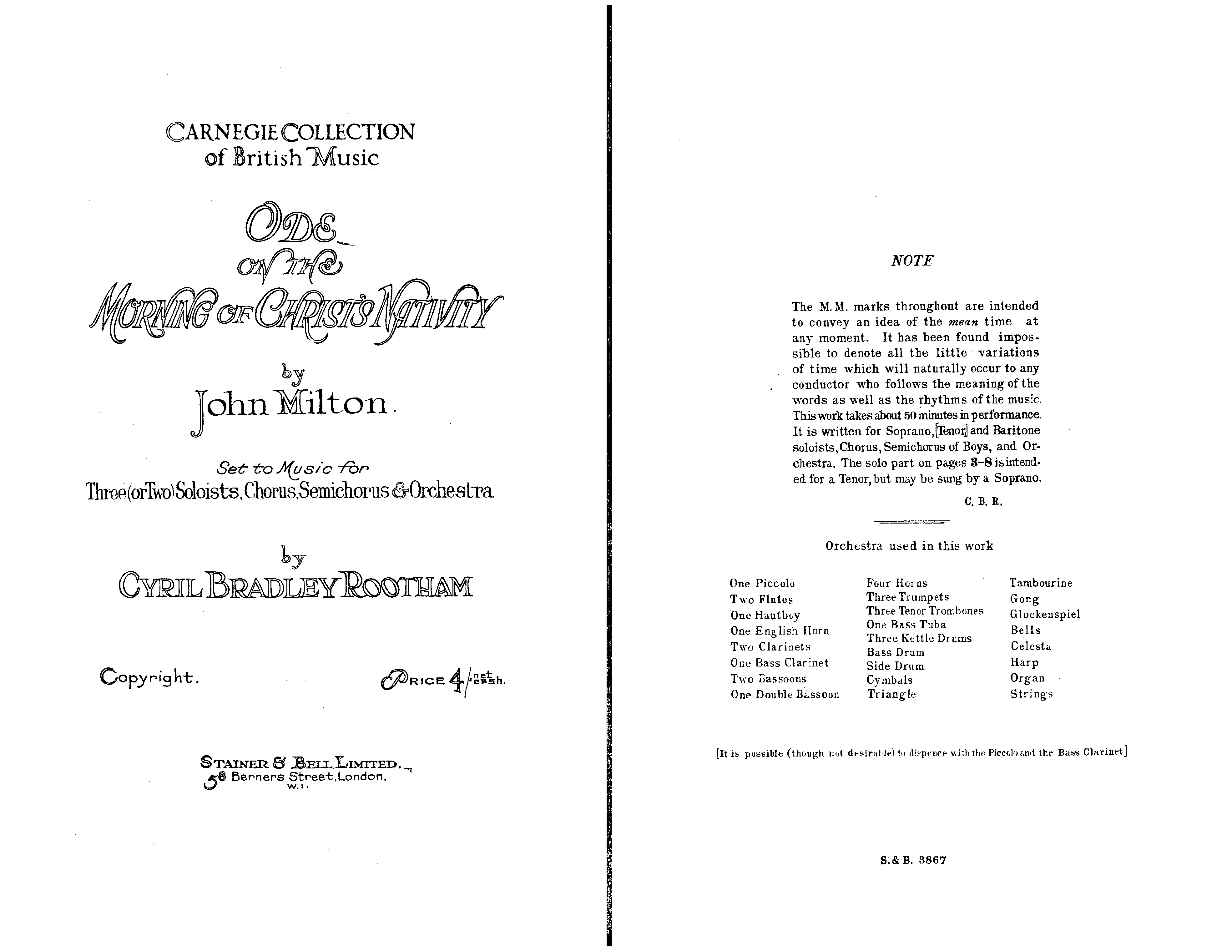
Completed in 1927 by Cyril Bradley Rootham (CBR), this ambitious setting of Milton's poem was regarded by the composer himself as his finest work.
Outline of this work
Opus 81 "Ode on the Morning of Christ's Nativity" was composed in the period 1925-1927, and won for Cyril Rootham a prestigious Carnegie Award in 1928.
The work is scored for soloists (soprano, tenor, baritone), chorus, semi-chorus of boys and orchestra. The programme notes from this 1962 performance were written by the composer's son Jasper and can be downloaded as a PDF file (24Mb). The concert programme also contains the entire lyrics of Milton's poem.
Publication status
CBR's "Ode on the Morning of Christ's Nativity" was beautifully typeset as a result of winning the Carnegie award, and this original edition is still available for hire from Stainer & Bell. The work carries the catalogue number HL167 in their Hire Library.
This performance
This historic first recording of CBR's "Ode" Op.81 features the Cambridge University Musical Society, conducted by David Willcocks. The recording was made at a concert given in the Chapel at King's College, Cambridge, on 28 November 1962. The soloists were Honor Sheppard (soprano), Wilfred Brown (tenor) and John Lawrenson (bass).
The total duration is just over 42 minutes. There was a technical problem part-way through the recording, involving the disconnection of one of the microphones. Because of this, the soloists sound rather distant in the latter part of the performance. In addition, this recording has been recovered from an LP once belonging to Jasper Rootham. The record has been played many, many times and is slightly damaged in places. We are very grateful to Samsound for restoring this unique recording.
Historical note
CBR's "Ode on the Morning of Christ's Nativity" was first performed on 13 June 1930 in a performance by the Cambridge University Music Society choir and orchestra, conducted by the composer.
A performance in Gloucester at the 1934 Three Choirs Festival brought further acclaim, and the 1975 Vernon Handley recording (see below) was broadcast on BBC Radio 3 on 18 December 1975 and 23 December 1980.
Available on CD
As part of the centenary celebration of Rootham's birth, the Nativity Ode was also broadcast on Radio 3 on 18 December 1975: on that recording Vernon Handley conducted the BBC Concert Orchestra, BBC Singers and Trinity Boys Choir.
This 1975 recording is now available as part of the Itter Broadcast Collection on the Lyrita label as catalogue REAM2118 through Presto Classical: this is a 2-CD set which also includes Rootham's Symphony No 2 (Op.97) recorded in 1984.
Here is a link to Presto Classical's informative page about the CD set:
• Cyril Rootham: Op.81 Ode on the Morning of Christ's Nativity and Op.97 Symphony No 2 in D major
John Milton (1608-1674) Author of "On the Morning of Christ's Nativity"
David Willcocks (1919-2015) Conductor of this recording
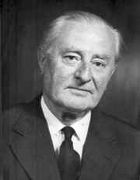
Jasper Rootham (1910-1990) Son of the composer
Jasper Rootham was also instrumental in getting major works by Cyril Rootham performed and recorded by other conductors, including Richard Hickox and Vernon Handley.